
About PAR
Participatory action research (PAR)
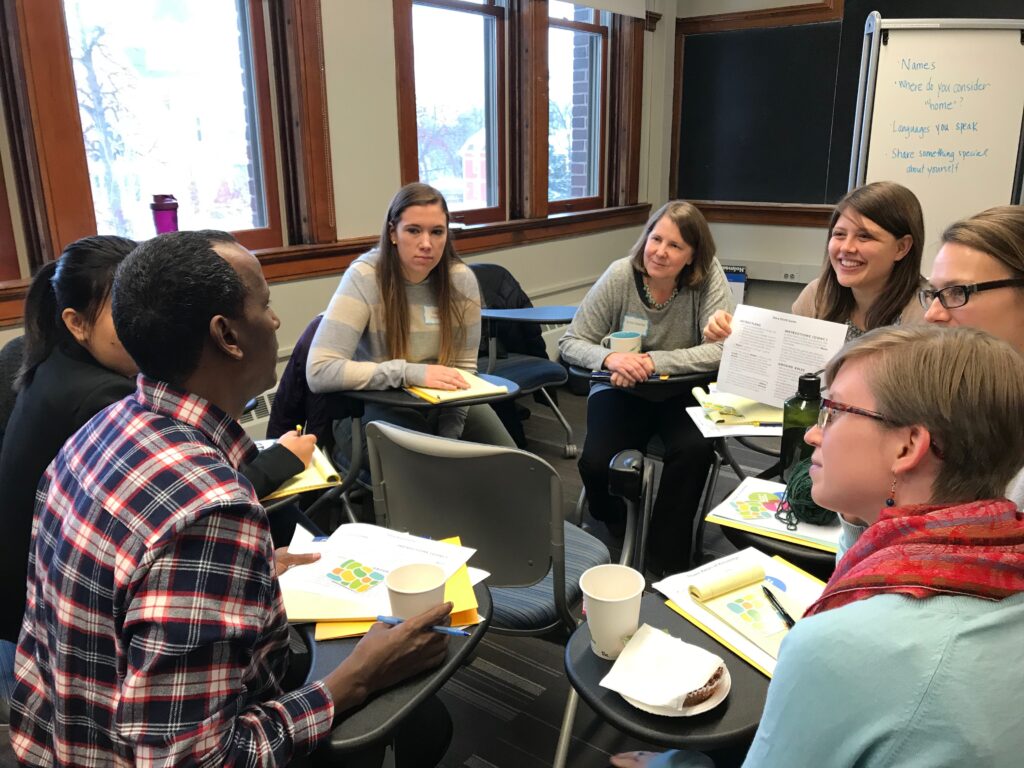
is a framework for conducting research and generating knowledge centered on the belief that those who are most impacted by research should be the ones taking the lead in framing the questions, the design, methods, and the modes of analysis of such research projects. The framework is rooted in the belief that there is value in both traditionally recognized knowledge, such as scholarship generated by university-based researchers, and historically delegitimized knowledge, such as knowledge generated within marginalized communities.
Participatory action research differs from social justice–oriented research conducted by university-based researchers because PAR involves affected community members in all aspects of the research. Andrea Dyrness explains that while “activist research often tries to shift the balance of power by changing how research is used,” such research does not necessarily change the research process (Dyrness, 2011, p. 203). In contrast, she argues that participatory action research assumes that “‘ordinary’ people also produce knowledge that is useful in struggles for change, and [that] the research process itself could be an important arena for making change” (p. 203). PAR aims to make the research process more democratic and collaborative.
The PAR framework provides one way for critical reflection on problems of social inequity, attempting to move beyond the divisions that often exist between universities and their surrounding communities. Michelle Fine (2018), a researcher foundational in developing the PAR framework in the field of education, explains, “Like the arts, independent media, and social movements, in moments of crisis, critical participatory action research can carve out delicate spaces for fragile solidarities and collective inquiries, and even more valid research, where we might join with others to collectively ignite the slow fuse of possible” (p. 123).
PAR assumes that people in a particular context want to study themselves and their practices with the aim of changing their practices to make their context better. Rather than imposing research projects or solutions onto a community, PAR projects provide targeted community groups with the tools and skills to study their context in order “to transform ‘the way we do things around here’” (McTaggart et al., 2017, p. 28). PAR projects are contextually specific; they are focused on “what happens here, in this single case—not what goes on anywhere or everywhere” (p. 28). PAR projects can involve a range of research methodologies, and findings can be disseminated in various ways, including through art and performance.
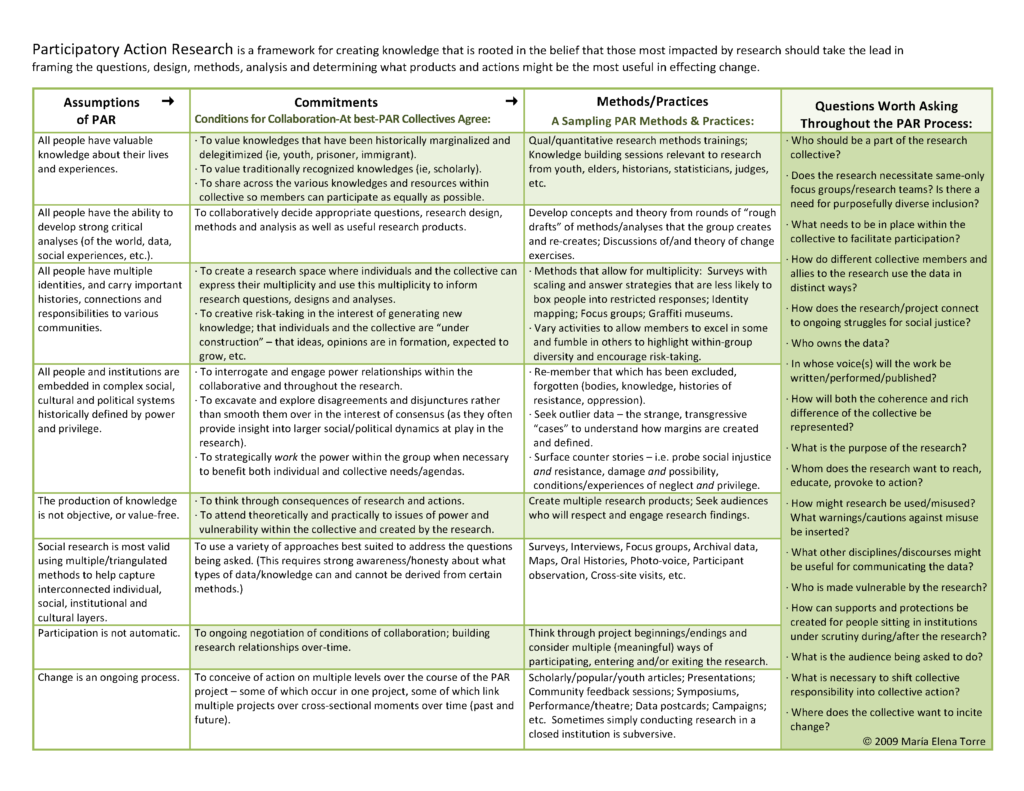
As PAR scholars have noted, these projects take time, and the process is often messy and unpredictable. There will be inevitable conflicts of interests, ideas, and identities. The principles of participatory action research encourage everyone involved in the research to “excavate and explore disagreements and disjunctures rather than smooth them over in the interests of consensus” (Torre, 2009).
Watch this video to learn from various experts about what PAR is and why it matters
Dyrness, A. (2011). Mothers united: An immigrant struggle for socially just education. University of Minnesota Press.
Fine, M. (2018). Just research in contentious times: Widening the methodological imagination. Teachers College Press.
McTaggart, R., Nixon, R., & Kemmis, S. (2017). Critical participatory action research. In L. L. Rowell (Ed.), The Palgrave international handbook of action research (pp. 21-35). Springer. https://doi.org/10.1057/978-1-137-40523-4_2
Torre, M. E. (2009). PAR-Map [PDF file]. Retrieved from https://actionresearch.mit.edu/sites/default/files/documents/PAR-Map.pdf
History of PAR
The origins of PAR cannot be traced back to any one lineage; instead, participatory action research is a convergence of multiple traditions, ranging from academic fields of social work, public health, and education to popular social justice movements. PAR also developed distinctly all across the world. As Fine and Torre note, in each of these varied places,
“PAR developed out of the rich soil of critical, community knowledges held by ‘insiders’ to community life. As those insiders sat at the bottom of social arrangements, they witnessed the holes in the ideological stories told, the practices engaged, and the contradictions that sustain stratification” (2004, p. 18).
There are two particularly prominent lineages: that of psychologist Kurt Lewin and his work to develop what he termed “action research” and that of Latin American popular social reform movements informed by the thinking of Paulo Freire and other activists. Contemporarily, a movement of critical PAR seeks to (re)orient the framework toward decolonizing theories.
Fine, M., & Torre, M. E. (2004). Re-membering exclusions: Participatory action research in public institutions. Qualitative Research in Psychology, 1(1), 15–37. https://doi.org/10.1191/1478088704qp003oa
Zeller-Berkman, S. M. (2014). Lineages: A past, present, and future of participatory action research. In P. Leavy (Ed.), The Oxford handbook of qualitative research (pp. 518–532). Oxford University Press.
Kurt Lewin
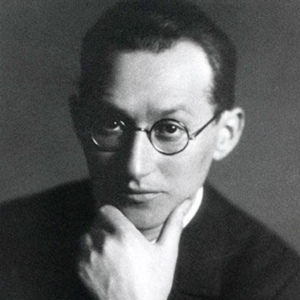
"The best way to understand something is to try to change it."
Kurt Lewin came to the United States as a Jewish refugee from Nazi Germany during the 1930s. Influenced by Marxism, Lewin wanted to study anti-Semitism and the subjugation of Jewish communities while also taking action against it; he began to study group dynamics and the psychology of minority communities. As he delved deeper into this work, Lewin became increasingly committed to using research to effect social change. As a member of the Commission on Community Interrelations (CCI) formed in 1945 by the American Jewish Congress, Lewin pushed for research on minority communities to be done outside of the academy, within the studied communities themselves (Cherry & Borshuk, 1998). Counter to psychological approaches of the time, Lewin’s philosophy “implicated all members of society as responsible for changing the conditions that create so-called minority problems” (Zeller-Berkman, 2014). Specifically, he wrote, “In recent years we have started to realize that so-called minority problems are in fact majority problems, that the Negro problem is the problem of the white, that the Jewish problem is the problem of the non-Jew, and so on” (Lewin, 1946, p. 44).
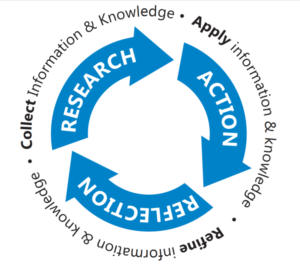
Lewin introduced the term action research to describe the study of a social problem with the intent to change it. He envisioned action research, and participatory action research, as a continuous self-reflective cycle of inquiry, action, and evaluation, undertaken collectively with or by society’s marginalized peoples (Torre, 2014; Cherry & Borshuk, 1998; Zeller-Berkman, 2014). Lewin wrote, “Fact-finding has to include all the aspects of community life—economic factors as well as political factors or cultural tradition. It has to include the majority and the minority, non-Jews and ourselves” (Cherry & Borshuk, 1998, p. 126).
Cherry, F., & Borshuk, C. (1998). Social action research and the Commission on Community Interrelations. The Journal of Social Issues, 54(1), 119–142. https://doi.org/10.1111/j.1540-4560.1998.tb01210.x
Greenwood, D. J., & Levin, M. (1998). Introduction to action research: Social research for social change. Sage Publications, Inc.
Lewin, K. (1946). Action research and minority problems. The Journal of Social Issues, 2(4), 34–46. https://doi.org/10.1111/j.1540-4560.1946.tb02295.x
Torre, M. E. (2014). Participatory action research. In T. Teo (Ed.), Encyclopedia of critical psychology. Springer. https://doi.org/10.1007/978-1-4614-5583-7_211
Zeller-Berkman, S. M. (2014). Lineages: A past, present, and future of participatory action research. In P. Leavy (Ed.), The Oxford handbook of qualitative research (pp. 518–532). Oxford University Press.
Latin American Legacy
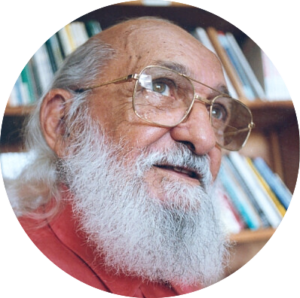
The Latin American revolutionary lineage of PAR includes thinkers such as Paulo Freire, a Brazilian advocate for critical pedagogy and popular education, and Orlando Fals Borda, a Colombian sociologist.
According to Zeller-Berkman (2014), a legacy of corrupt and exploitative international development efforts of the 1960s and 1970s led social scientists in Latin America to develop self-sufficiency within research processes, taking control of and decolonizing the means of knowledge production. In this lineage of PAR, the role of the academic researcher was to be the “animator,” or the person who facilitated the transformation of common community knowledge to critical knowledge. The eventual goal was to have the community researchers gain enough research skills so they could use these practices independently of academia to engage in inquiry into their own communities, produce their own knowledge, and develop their own solutions. Central to the PAR process, then, was capacity building and community organizing; Fals Borda called this combination of community organizing, popular education, and social science research a “people’s science” (Fals Borda, 1977).
Paulo Freire’s thinking around critical pedagogy and popular movements was central to the development of this decolonizing research process (Torre, 2014). Freire advocated for a democratic education and research system, in which people and communities were involved in the production of knowledge about themselves, and a social system in which this community knowledge was valued as an equal to university-based knowledge. A major theme in Freire’s process and work was the raising of critical consciousness—or conscientização—of one’s social and political situation through a cycle of inquiry, reflection, and action (Torre, 2014; Zeller-Berkman, 2014).
Fals Borda, O. (1977). Por la praxis: El problema de cómo investigar la realidad para transformarla. In O. Fals Borda (Ed.), Crítica y política en ciencias sociales. Punta de Lanza.
Rahman, M. (1991). The theoretical standpoint of PAR. In O. Fals Borda & M. Rahman, Action and knowledge: Breaking the monopoly with participatory action research (pp. 13–24). Apex Press.
Torre, M. E. (2014). Participatory action research. In T. Teo (Ed.), Encyclopedia of critical psychology. Springer. https://doi.org/10.1007/978-1-4614-5583-7_211
Zeller-Berkman, S. M. (2014). Lineages: A past, present, and future of participatory action research. In P. Leavy (Ed.), The Oxford handbook of qualitative research (pp. 518–532). Oxford University Press.
Contemporary Critical PAR
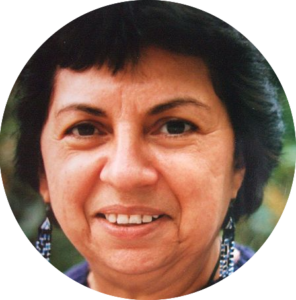
More recently, critical race and feminist scholars are re-centering PAR’s liberatory and decolonizing history. Wary of the potential co-optation of PAR by stakeholders with power (Fine, 2009; Torre, 2014), these researchers emphasize the framework’s connection to queer, feminist, Marxist, and Indigenous theories (Torre, 2014; Torre et al., 2012).
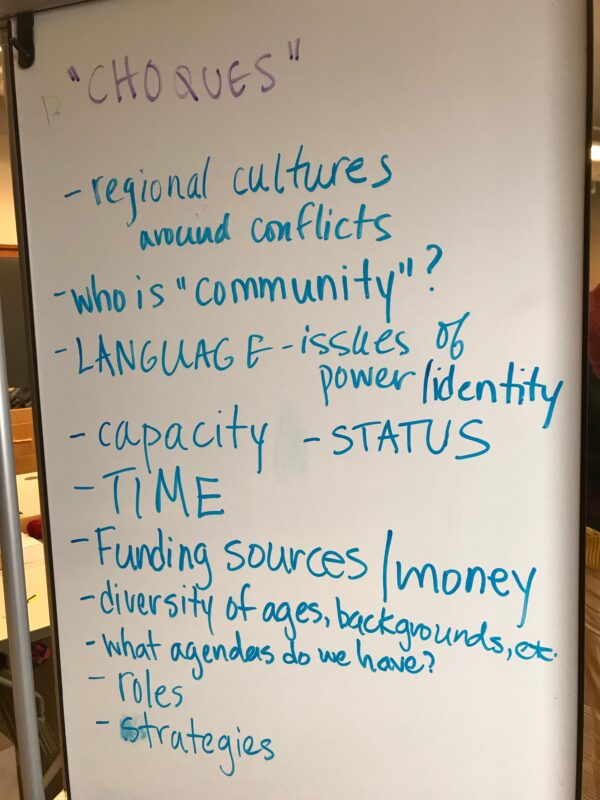
Some scholars have linked PAR with Gloria Anzaldúa’s Borderlands theories (Anzaldúa, 1987), advocating for a PAR that “embraces mestizaje” and welcomes conflict—or choques—rather than only organizing around consensus (Torre & Ayala, 2009, p. 390). These scholars note that even within research collectives that do participatory research under common goals, “individual co-researchers carry particular interests, agendas, are differently situated with regard to resources and privilege;” these borders and nuances can be valuable spaces of knowledge creation, because they reflect conflicts that go beyond the research collective (Torre & Ayala, 2009, p. 388).
Moreover, PAR scholars center the experiences and theories of women of color as critical spaces of knowledge, pointing out that “mestiza consciousness houses multiplicity, hybridity, conflict and collaboration, within the bodies of women of color… From this consciousness, knowledge is presumed as existing within the flesh, with theory-making as part of the collective existence for women of color” (Ayala, 2009, p. 72).

(Linda Tuhiwai Smith, a Maori scholar, in her book Decolonizing Methodologies: Research and Indigenous Peoples, p. 10)
Anzaldúa, G. E. (1987). Borderlands/La frontera: The new mestiza. Aunt Lute Books.
Ayala, J. (2009). Split scenes, converging visions: The ethical terrains where PAR and Borderlands scholarship meet. The Urban Review, 41, 66–84. https://doi.org/10.1007/s11256-008-0095-9
Fine, M. (2009). Postcards from Metro America: Reflections on youth participatory action research for urban justice. The Urban Review, 41, 1–6. https://doi.org/10.1007/s11256-008-0099-5
Torre, M. E. (2014). Participatory action research. In T. Teo (Ed.), Encyclopedia of critical psychology. Springer. https://doi.org/10.1007/978-1-4614-5583-7_211
Torre, M. E., & Ayala, J. (2009). Envisioning participatory action research entremundos. Feminism & Psychology, 19(3), 387–393. https://doi.org/10.1177/0959353509105630
Torre, M. E., Fine, M., Stoudt, B., & Fox, M. (2012). Critical participatory action research as public science. In P. Camic & H. Cooper (Eds.), The handbook of qualitative research in psychology: Expanding perspectives in methodology and design (2nd ed., pp. 171–184). American Psychological Association. https://doi.org/10.1037/13620-011
Common Types of PAR
While most PAR projects tend to share common themes, such as being led by community members most affected by the research, equity and inclusion throughout the research process, honoring diverse forms of knowledge, and the intent to act on findings through social change, there are a few different kinds of projects.
It is helpful to delineate the differences among these various types of PAR, but actual projects often contain elements of various types. For example, a university-based scholar might collaborate with a high school teacher to understand and improve the teacher’s practice, or adults in a community-based organization might collaborate with youth in their community on a PAR project.
The rest of the site is framed around these four types of PAR, allowing you to quickly find resources and examples relevant to your particular area of focus:
Youth Participatory Action Research (YPAR)
YPAR is an approach to community development in which youth take the lead, partnering with adults to create change or find a solution to a problem.
Teacher Action Research (TAR)
TAR is a method for educators to understand, evaluate, and improve their own practice.
Community-Based PAR (CBPAR)
CBPAR is an approach in which a project is co-led in all phases by community members and academic researchers with the intent that findings will be used to change inequitable practices and systems.
University-Community PAR Collaborations
UCPAR collaborations tend to be started by university-based scholars reaching out to community members to conduct collaborative research around community issues that are aligned with the scholars’ area of research and discipline.
Ethics of PAR
A consideration of ethics is important in all research projects, including participatory action research projects.
There are different ways to think about ethics:
- There are often rules and regulations researchers need to follow that consider the well-being of people who are participating in research studies. Institutional review boards, often affiliated with universities, are committees that oversee the ethics of research studies.
Watch this video to learn about how IRBs protect human research participants
There are also community-based review boards such as the Bronx Community Research Review Board (BxCRRB):
The Bronx Community Research Review Board (BxCRRB)
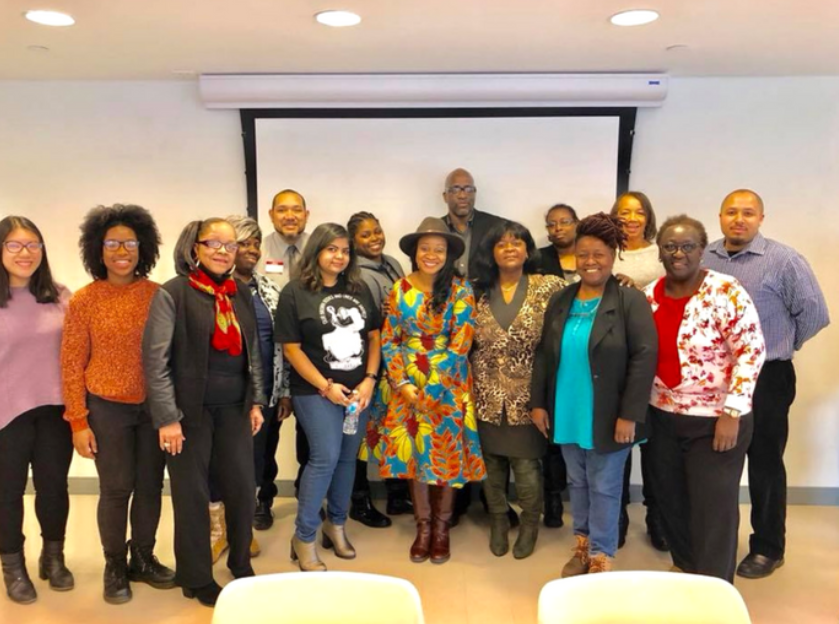
The BxCRRB advocates ensuring that every community member has a voice and is heard. It was founded to add community-focused oversight to the research review process in order to protect the disadvantaged and vulnerable populations in the Bronx from academic research abuse, such as lying about the potential dangers of studies or violating their human rights. The review process also works with researchers and advises them on how to approach the community in a way that is culturally sensitive.
- Ethics guide decision-making about research questions, methods, and so forth.
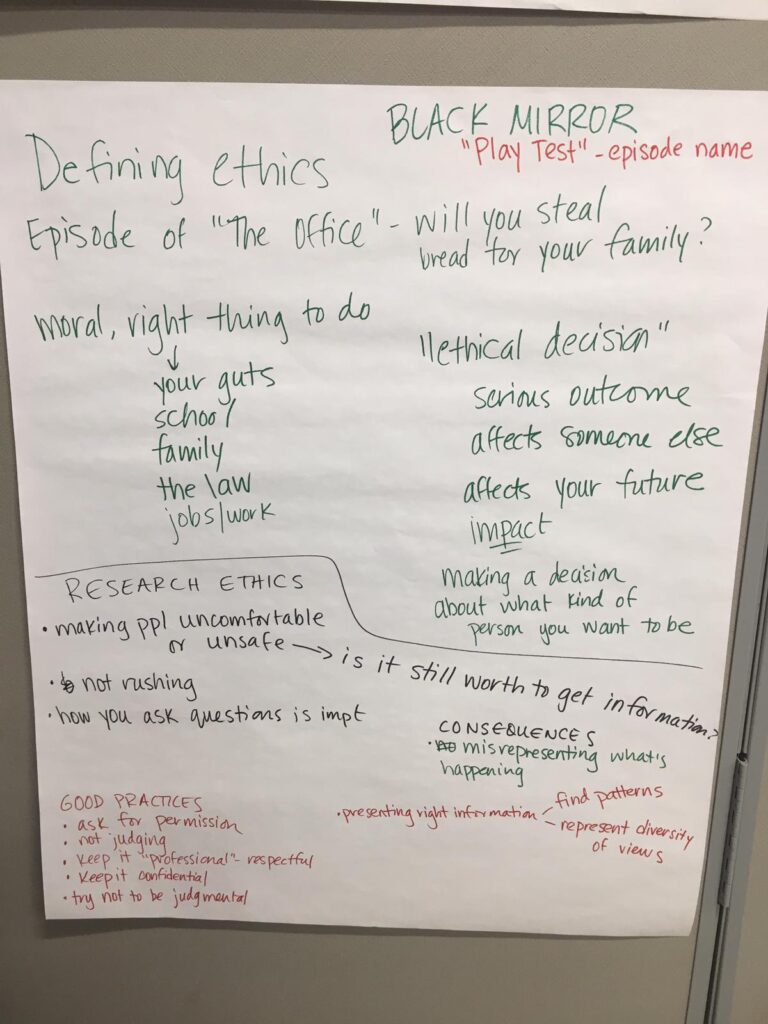
- There are also the everyday and on-the-ground ethics which guide how we work with others in the research process.
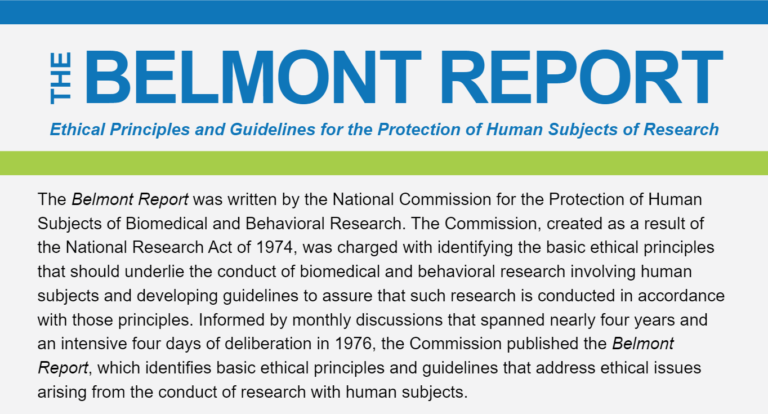
- Then in regards to regulations, there must be “respect for persons, beneficence, and justice.” This is from The Belmont Report:
- Because PAR projects often involve communities who have been historically marginalized and oppressed, the history of unethical medical research practices in the United States, particularly targeting communities of color, are an important part of how we need to understand ethics.
Two examples of such unethical practices are what happened during the Tuskegee Experiment:
(Learn more about the Tuskegee experiment: Reverby, S. M. (Ed.). (2012). Tuskegee’s truths: Rethinking the Tuskegee syphilis study. UNC Press Books.)
…and what happened with Henrietta Lacks:
(Learn more about Henrietta Lacks: Skloot, R. (2017). The immortal life of Henrietta Lacks. Broadway Paperbacks.)
- PAR researchers might want to consider the following questions on an ongoing basis: How are you ensuring that you’re following the ethical principles that are central to any research, but especially to community-based participatory research (e.g., mutual respect, equality and inclusion, democratic participation, collective action, and so forth)?
- To learn more about what ethics look like in practice beyond consent forms in community-based participatory research, check out this team’s work with LGBT youth in the United Kingdom.
The various community research groups in the Carleton-Faribault project explored both research and everyday ethics in their groups:


For further exploration:
- “A Guide to Ethical Principles and Practice.” Developed by the Durham University’s Centre for Social Justice and Community Action, and published by the National Coordinating Centre for Public Engagement.
- A presentation on “Tackling Ethical Challenges in Community-Based Participatory Research” by Sarah Banks from Durham University.
- This PAR checklist created by Katie Johnston-Goodstar and Jenna Sethi is helpful in thinking through many of the ethical dimensions of PAR projects.
